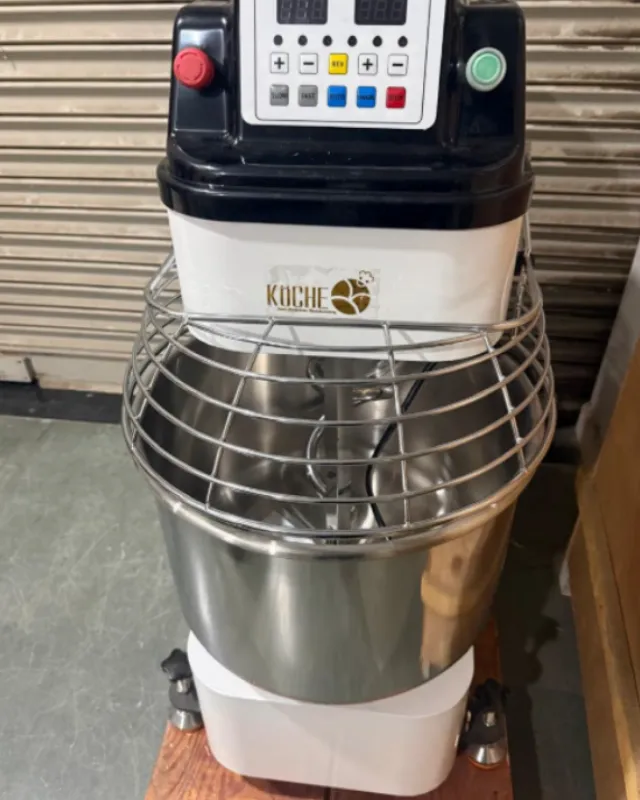
Mixing dough manually becomes increasingly difficult as bakery production expands. Larger batches demand consistent mixing time, suitable dough development, repeatable handling. A Spiral Mixer machine is designed to support commercial dough preparation where volume plus consistency matter.
The equipment is commonly associated with bread, pizza, bun, similar dough-based production.
How Spiral Mixing Works
A spiral mixer uses a spiral-shaped mixing tool inside a bowl to process dough efficiently.
Its working action is particularly suitable for dough preparation because the mixing mechanism helps combine ingredients while developing the dough structure required for many yeast-based bakery products.
Exact operating procedures depend on machine design, recipe, batch quantity.
Operators should therefore follow appropriate mixing times rather than assuming every dough requires identical processing.
Where Spiral Mixers Are Commonly Used
Commercial spiral mixers can support production in:
- Bread bakeries
- Pizza kitchens
- Bun manufacturing units
- Commercial food kitchens
- Hotel bakery departments
- Cafe production facilities
- Central bakery kitchens
- Food processing businesses
A bakery producing dough several times throughout the day may gain more operational value from dedicated mixing equipment than a business making very small occasional batches.
Consistency Becomes Important at Scale
Customers expect familiar texture each time they buy a bakery product.
If dough is under-mixed in one batch, excessively processed in another, the resulting products may differ.
Machine-assisted preparation can make it easier to standardise procedures around batch weight, ingredient sequence, mixing duration.
This does not eliminate the importance of recipe knowledge. Flour characteristics, hydration, ambient conditions, fermentation still influence dough behaviour.
The machine provides a controlled production tool; bakery expertise determines how effectively it is used.
Choose Capacity Carefully
Mixer capacity should match practical batch requirements.
Buying an oversized mixer for very small batches may not provide the most efficient workflow. Choosing insufficient capacity can create repeated mixing cycles during busy periods.
Estimate how much dough is required per production cycle.
For example, businesses supplying fresh bread throughout Nagpur may operate several scheduled batches during the day. Their mixer requirements may differ from a cafe preparing limited pizza dough.
Discuss actual dough quantities with the equipment supplier before choosing capacity.
Do Not Ignore Space Requirements
A commercial mixer requires a suitable operating area.
There should be adequate space for loading ingredients, operating controls, removing dough, cleaning surrounding areas.
Floor stability should also be considered according to equipment requirements.
In compact bakery kitchens, positioning the mixer close to ingredient preparation areas can reduce unnecessary movement.
Train Operators Around Batch Procedures
Equipment delivers better consistency when operating procedures are documented.
A basic production process can specify:
- Ingredient quantities
- Loading sequence
- Mixing stages
- Approximate mixing duration
- Dough evaluation method
- Unloading procedure
- Cleaning routine
These steps can help different operators reproduce the same production method.
Training is particularly valuable when bakeries employ multiple shifts.
Maintenance Should Be Planned
Unplanned mixer downtime can interrupt bread production quickly.
Routine checks should cover components specified by the manufacturer. Operators should report unusual sounds, unexpected vibration, control problems promptly.
Cleaning should be performed using approved methods after production.
Maintenance schedules become even more important for industrial bakery units where the mixer operates repeatedly throughout the working day.
Is a Spiral Mixer Suitable for Your Bakery?
The answer depends on product type, dough quantity, production frequency, available space, planned growth.
For bakery entrepreneurs in Nagpur, Maharashtra, the decision should be made after calculating realistic daily dough requirements.
Vaibhav Enterprises supplies bakery equipment for businesses evaluating commercial production machinery. When selecting a Spiral Mixer machine, providing the supplier with batch requirements plus product details can help narrow the specification.
The goal is straightforward: choose equipment that supports repeatable dough preparation without creating unnecessary capacity, complexity, workflow problems.
Keywords