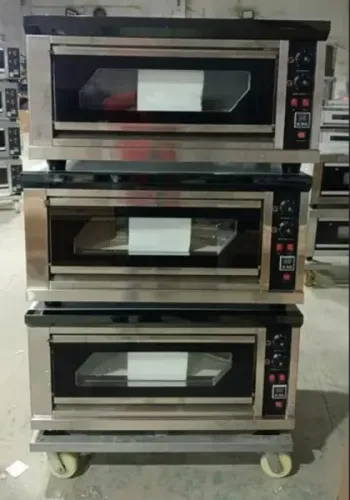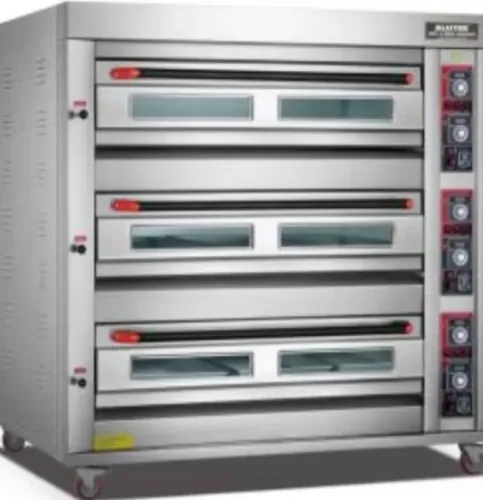
High-volume baking depends on saleable pieces per hour, not the burner’s headline rating or the number of trays listed on a specification sheet. By the end, you will be able to calculate usable capacity, compare oven types, test heat recovery, and specify the gas, controls, ventilation, and operating method your bakery needs.
Key takeaways
- Calculate output from loading, baking, unloading and recovery time.
- Compare burner recovery and fuel use, not oven chamber size alone.
- Assign deck temperatures to products with different baking requirements.
- Confirm gas, ventilation, electrical and clearance needs before requesting quotes.
Where a Gas Deck Oven Fits in a High-Volume Bakery
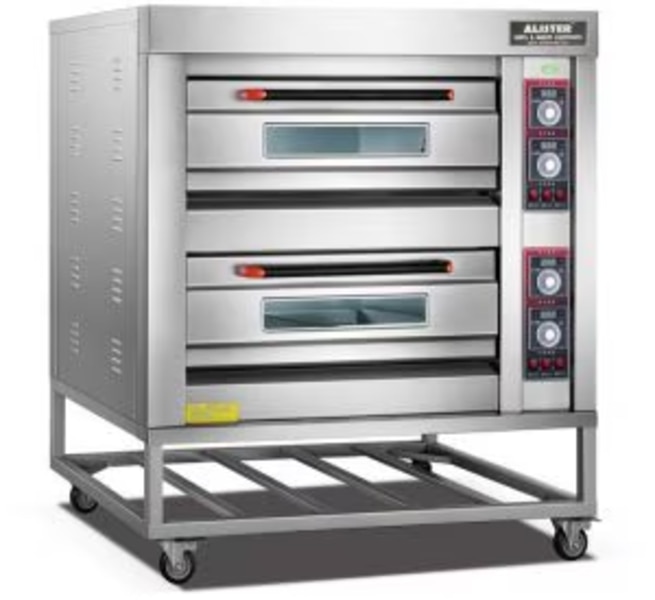
A gas deck oven machine fits high-volume bakery production when you sell repeatable batches of bread, buns, pizza, biscuits, or regional hearth products rather than a continuous stream of identical pieces. Its hearth supplies strong conductive bottom heat, while radiation from the roof and sidewalls develops crust and colour.
The trade-off is slower changeover between products and less airflow uniformity than a rack-style oven.
| Option | Advantage for batch production | Limitation |
|---|---|---|
| Gas deck oven | Firm hearth bake, independent deck scheduling, flexible batch sizes | Needs loading discipline and recovery time |
| Rotary rack oven | Even airflow across many trays; efficient for varied tray products | Weaker hearth character and greater trolley-handling space |
| Convection oven | Fast, uniform airflow around trays; useful for cookies and pastries | Less bottom heat and crust development |
| Tunnel oven | Continuous output with stable product flow | Poor fit for frequent product changes and smaller batches |
| Electric deck oven | Precise deck heat without combustion exhaust | Electrical demand and tariff exposure can raise running cost |
Choose gas when batches share similar bake profiles and each deck has separate temperature and steam controls. Gas is not automatically cheaper: compare quoted consumption at your load with electric tariffs. Ignition, controls, fans, and steam equipment still need electricity, so plan for voltage protection and outages.
Calculate Capacity from the Complete Baking Cycle
A deck oven capacity calculation starts with usable deck area, not the advertised tray count. Measure the hearth space that remains after clearances, then confirm how many standard trays fit without touching walls or blocking heat flow. Ask whether the stated tray capacity uses your tray dimensions or a supplier-specific size.
- Record saleable pieces per tray and multiply by the number of trays loaded at once.
- Add bake time, unloading time, loading time, and the recovery period before the next batch.
- Include cleaning, temperature changes, and product changeovers in the cycle when they occur during the shift.
- Divide 60 minutes by the complete cycle in minutes, then multiply by saleable pieces per batch.
For example, four trays holding 12 buns each produce 48 pieces per batch. A 24-minute bake, six minutes for unloading and loading, and five minutes of recovery create a 35-minute cycle: 1.7 batches per hour, or about 81 pieces before allowances.
Compare that result with your hourly target, then reduce it for rejects, uneven deck zones, and operator delays. A gas deck oven is a batch machine; products with different bake times can leave decks waiting for the longest-running item.
Test capacity using your normal dough weight, tray loading pattern, and mapped production temperature rather than an empty-oven reading.
Measure Burner Recovery, Fuel Use, and Hourly Cost
A 30 kW burner does not automatically recover faster than a 20 kW burner. Compare delivered heating performance at your normal load: burner output, heat-up time from cold, and oven recovery time after a full door opening.
Refractory mass improves temperature stability but extends warm-up; poor insulation, a leaking gasket, obstructed flues, or incorrect burner adjustment can erase the advantage.
Ask for these figures during a witnessed test:
- Minutes to reach the production setpoint from cold
- Temperature drop and recovery time after loading a full deck
- Gas consumption during warm-up, baking, and idle periods
- Deck temperature readings at several points with product loaded
Recovery affects throughput because a slow oven forces longer gaps between batches or produces pale centres while the deck catches up. A higher burner rating cannot compensate for uneven heat distribution or excessive door opening.
Calculate hourly fuel cost by multiplying measured gas consumption in kilograms per hour for LPG or cubic metres per hour for PNG by your local fuel rate. Add electricity for controls and extraction, then include warm-up and standby gas spread across the day’s saleable batches.
Compare that result with electric heating under the same schedule; gas is not automatically cheaper. Use the complete cycle, including recovery and handling, to find actual saleable pieces per hour.
Control Heat by Deck for Different Products
Even baking depends on separate control of the deck temperature, not burner size alone. An independent deck thermostat lets you run one deck hotter for pizza while another bakes bread or buns at a lower setting.
Specify adjustable top and bottom heat so you can correct pale tops, burnt bases, or uneven browning without changing the whole oven.
| Product | Heat-transfer requirement | Control to verify |
|---|---|---|
| Pizza | Strong conduction for a crisp base and radiant top heat for blistering | Stone deck, high bottom heat, adjustable top heat |
| Bread | Even hearth heat plus moisture during oven spring | Stable bottom heat, balanced top heat, steam control |
| Buns | Moderate hearth contact without scorching the base | Independent thermostat and separately adjustable top and bottom heat |
| Biscuits | Consistent tray heat across the deck | Even stone temperature and low hot-spot variation |
| Cookies | Controlled base colour without excessive radiant browning | Reduced bottom heat and stable thermostat response |
A stone deck stores heat and transfers it directly into dough, but a badly installed stone or blocked flue creates hot and cold zones. Ask for a temperature map across each deck at normal production load, not an empty-oven reading.
Test recovery after opening the door; a slow recovery changes bake colour from one batch to the next. Steam control also needs its own adjustment, because excess moisture softens cookies while insufficient steam limits bread volume and crust development.
Use a Loading Routine That Protects Throughput
Load each batch with consistent piece weights and tray counts; overcrowding blocks heat flow and turns nominal capacity into wasted pieces. A fixed oven loading sequence keeps operators from opening the door repeatedly to find space or correct misplaced trays.
1. Pre-stage every filled tray beside the oven and label its deck position. Load the fastest-baking tray last if unloading must happen in a fixed order.
2. Leave the manufacturer’s specified tray spacing and clear the deck edges and flue openings. Trays touching each other create pale strips and restrict heat circulation.
3. Rotate trays only when the product profile requires it or a mapped hot spot demands it. Turn them quickly at the scheduled point, then shut the door immediately.
4. Check one batch at a planned time near the end of its bake instead of opening the door repeatedly. Use colour, crust set and internal temperature to release the batch.
5. Unload completed trays before loading the next batch, then close the door during staging. Keep a second set of trays ready so handling time does not become recovery time.
Group products with similar temperatures and bake times. During a product changeover, remove crumbs, reset deck controls and allow the oven to recover before loading the next profile. Otherwise, the first tray can inherit heat from the previous product and produce an avoidable uneven batch.
Specify the Installation Before You Compare Quotes
A quote is incomplete until it states the installation conditions, not just the oven price. Confirm local LPG and PNG compatibility, inlet pressure, regulator and cylinder-bank sizing, and an authorised gas installation. A fuel change needs the correct orifices and combustion settings; a hose swap is unsafe.
| Item | Confirm before quote | Failure if missed |
|---|---|---|
| Gas | Fuel, pressure, isolation valve, leak test | Unstable flame, soot or delayed ignition |
| Ventilation | Flue route, combustion exhaust, hood, make-up air | Carbon monoxide risk or flame failure |
| Electrical | Voltage, load, earthing, surge protection and backup plan | Ignition or controller failure during fluctuations |
| Water | Inlet pressure, filtration, drain and steam connection | Scale, blocked valves or poor steam output |
| Service | Response time, local technician and stocked burner, controller and ignition spares | A small fault stops production for days |
| Acceptance | Gas-leak test, burner commissioning, loaded bake test and temperature mapping | An empty-oven reading hides uneven decks |
Negative kitchen pressure can pull combustion air away from the burner, so test the oven with the hood operating. Ask for temperature mapping at your normal product load, not only the set-point display. In Nagpur, ask Vaibhav Enterprises to record the measured gas consumption, recovery time and acceptance readings in the handover sheet.
Related products
 | Digital Gas Oven Number Of Decks Double For Baking Biscuit/Cookies, Pizza, Bread/Bun Operation Type Automatic Power Source Gas Deck Size 26 X 33 Dimensions (W x D x... View product → |
 | Gas Deck Oven Number Of Deck 1 Deck For Baking Pizza Operation Type Automatic Power Source Gas Size Small / Mini Usage/Application Bakery Door Type Single Door... View product → |
Frequently asked questions
How do you calculate gas deck oven capacity for high-volume production?
Calculate output from the complete cycle: loading, baking, unloading and the time needed for the deck to recover temperature. Multiply the number of products per load by completed cycles per hour.
What should you compare when estimating a gas deck oven’s hourly cost?
Compare burner recovery, fuel consumption and the oven’s total hourly operating cost. A larger chamber is not automatically cheaper if it takes longer to recover between loads.
Can different products be baked in separate decks?
Yes. Use individual deck controls to set different temperatures for products such as bread, buns, pizza and biscuits, then verify results with trial bakes.
What installation details should you confirm before comparing oven quotes?
Confirm the gas type and pressure, burner capacity, flue and ventilation route, electrical supply, floor space, service access and required clearances.
Related products
 | Gas Deck Oven Number Of Decks Triple For Baking Bread/Bun, Biscuit/Cookies, Pizza Operation Type Automatic Power Source Gas Size Large Usage/Application Hotels &... View product → |
 | Gas Deck Oven Number of Trays 6 Tray Power Source Gas For Baking Bread/Bun, Pizza, Biscuit/Cookies Operation Type Automatic Size Large Number Of Decks Triple... View product → |
 | Digital Gas Oven Number Of Decks Double Decks Operation Type Automatic Automation Grade Automatic Power Source Gas Size Large Certification CE Minimum order quantity:... View product → |